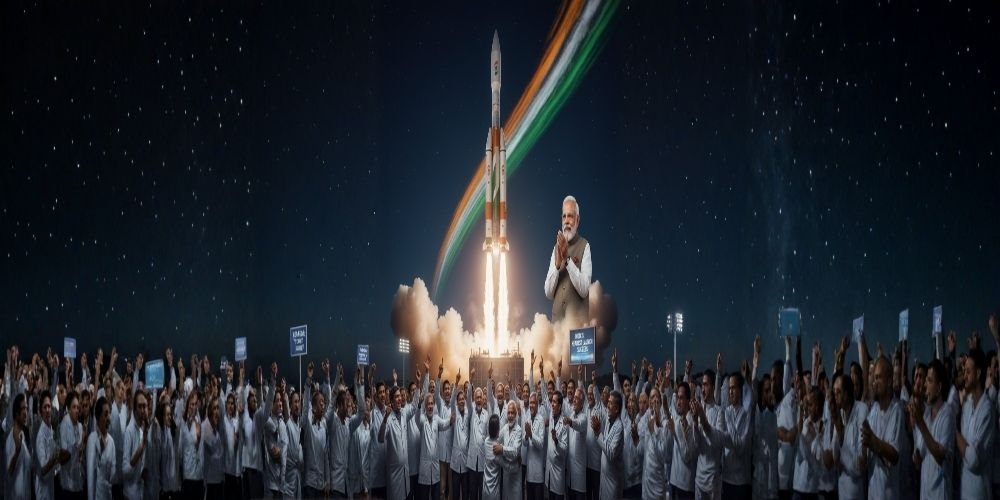
India’s Heaviest Satellite Launch: ‘Bahubali’ Rocket Triumphs, PM Modi Hails Scientists
ISRO’s ‘Bahubali’ Makes History: India Launches Its Heaviest Communication Satellite CMS-03
- In yet another milestone that cements India’s place among global space powers, the Indian Space Research Organisation (ISRO) has successfully launched its heaviest communication satellite, CMS-03. Weighing an impressive 4,410 kg, the satellite soared into space onboard the new-generation, homegrown LVM3-M5 — famously known as the ‘Bahubali’ rocket.
The launch took place at 5:26 PM on Sunday from the Satish Dhawan Space Centre in Sriharikota, Andhra Pradesh. With this mission, ISRO achieved a rare feat, marking another proud chapter in India’s technological advancement.
India’s @isro successfully launched the LVM3-M5 mission, placing its heaviest communication satellite CMS-03 into the Geosynchronous Transfer Orbit. The achievement highlights ISRO’s technical excellence and strengthens India’s leadership in global space exploration, improving communication and connectivity across the country and surrounding ocean regions.💐🙏 pic.twitter.com/xyz123
— Dr.RamaChandraReddy Yeluri ( Modi ka Parivar ) (@rcreddyy) November 3, 2025
The Power of ‘Bahubali’: India’s Strongest Rocket
Dubbed ‘Bahubali’ for its unmatched lifting capacity, the LVM3-M5 is a three-stage launch vehicle built entirely with indigenous technology. It features two solid strap-on motors (S200), a liquid core stage (L110), and a cryogenic upper stage (C25).
With every previous LVM3 mission — including the landmark Chandrayaan-3 — achieving success, the rocket now boasts a flawless 100% success rate across eight launches.
ISRO Chairman V. Narayanan commended the team’s achievement, emphasizing that this same rocket earlier carried the pride of India, Chandrayaan-3, to the Moon. “Today, it has given us yet another moment of national pride with the successful deployment of a heavier communication satellite,” he said.
CMS-03: Expanding India’s Communication Horizon
According to ISRO, CMS-03 is a next-generation multi-band communication satellite designed to deliver reliable connectivity across a vast oceanic region, including the Indian mainland. Built to operate for over 15 years, it replaces the ageing GSAT-7 series launched in 2013 and was precisely placed in the Geosynchronous Transfer Orbit (GTO).
Despite facing weather-related challenges during the countdown phase, ISRO’s team ensured flawless execution, marking another display of the organisation’s resilience and precision.
National Pride and Global Significance
Prime Minister Narendra Modi lauded the space agency’s success, noting that India’s “space sector continues to make us proud.” He praised ISRO scientists for powering the nation’s journey of excellence and innovation that has significantly contributed to national progress and livelihood empowerment.
Union Minister Jitendra Singh also extended congratulations to ISRO and the Prime Minister for steering India through a remarkable series of successful missions.
From Dependence to Self-Reliance
Until recent years, India relied on the French Guiana-based Kourou launch base and Arianespace’s Ariane rockets to lift its heavier satellites. For instance, the GSAT-11 satellite, weighing 5,854 kg, was launched aboard an Ariane-5 rocket in 2018. With the LVM3-M5 now carrying such payloads from Indian soil, ISRO has turned that dependence into complete self-reliance.
The LVM3 vehicle, built using indigenous technology including the advanced C25 cryogenic engine, stands as a testament to India’s engineering and innovation strength.
ISRO also confirmed that this rocket family will soon play a pivotal role in the upcoming Gaganyaan human spaceflight mission, employing the human-rated version known as HRLV
Looking Ahead
The successful launch of CMS-03 ushers in a new era of communication capability and confidence in homegrown technology. With each mission, ISRO is proving that India’s space programme isn’t just making history—it’s shaping the future.