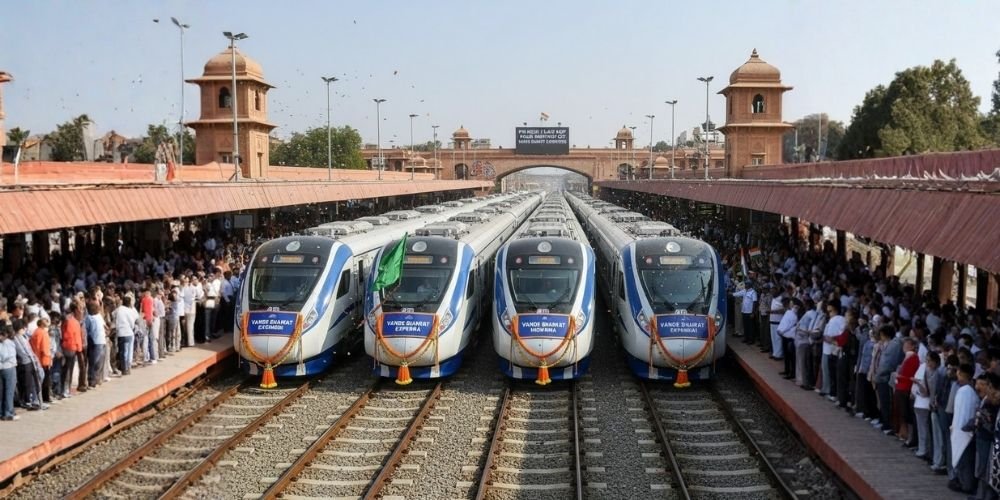
PM Modi Flags Off Four New Vande Bharat Express Trains from Varanasi
In a monumental boost to India’s railway infrastructure, Prime Minister Narendra Modi inaugurated four new Vande Bharat Express trains on Saturday from his parliamentary constituency, Varanasi. These new-age trains will now run on the Banaras-Khajuraho, Lucknow-Saharanpur, Firozpur-Delhi, and Ernakulam-Bengaluru routes—significantly enhancing rail connectivity across the country.
Vande Bharat: Accelerating India's Connectivity Revolution
During the inaugural event, PM Modi emphasized that the Vande Bharat project is “made by Indians, for Indians, and of Indians” — a symbol of national pride and technological progress. With the addition of these four trains, the total number of operational Vande Bharat Express services in India now exceeds 160, marking a new milestone for Indian Railways.
Highlighting the role of cutting-edge infrastructure in economic growth, the Prime Minister stated, “Infrastructure is a major factor in the growth of developed countries, and India is moving fast on this path.” He also affirmed that trains like Vande Bharat, Namo Bharat, and Amrit Bharat are laying the foundation for a new generation of Indian Railways.
Prime Minister Narendra Modi flags off four new Vande Bharat Express trains from Banaras Railway Station.
— Organiser Weekly (@eOrganiser) November 8, 2025
The newly launched trains will operate on the Banaras–Khajuraho, Lucknow–Saharanpur, Firozpur–Delhi, and Ernakulam–Bengaluru routes. pic.twitter.com/Z5h5TG7SVn
Banaras-Khajuraho Vande Bharat: Direct Link to Culture and Heritage
The newly launched Banaras-Khajuraho Vande Bharat Express will create a direct link between two culturally rich regions, reducing travel time by about two hours and 40 minutes compared to existing options. Connecting cities like Varanasi, Prayagraj, Chitrakoot, and Khajuraho, this service will especially benefit religious and cultural tourists.
This improved connectivity to the UNESCO World Heritage Site of Khajuraho is expected to boost both tourism and local economies, making pilgrimages and sightseeing trips faster, safer, and more comfortable.
Attended Inaugural run of Banaras-Khajuraho Vande Bharat Express by Hon' ble Prime Minister Narendra Modi ji @narendramodi
— Amit Tiwari (@amitghazipur10) November 8, 2025
#VandeBharatExpress pic.twitter.com/B16SP3MxkX
Lucknow-Saharanpur Vande Bharat: Faster Journeys across Uttar Pradesh
The Lucknow-Saharanpur Vande Bharat will now cover its route in approximately seven hours and 45 minutes, reducing journey times by nearly an hour. This train will benefit daily commuters and long-distance travelers from Lucknow, Sitapur, Shahjahanpur, Bareilly, Moradabad, Bijnor, and Saharanpur.
Improved access to the holy city of Haridwar via Roorkee will also drive regional spiritual tourism. The train is set to play a pivotal role in uplifting intercity travel and fueling regional development.
VIDEO | Lucknow: Visuals from inside the Lucknow-Saharanpur Vande Bharat Express, which will be flagged off by PM Modi shortly.
— Press Trust of India (@PTI_News) November 8, 2025
(Full video available on PTI Videos – https://t.co/n147TvrpG7) pic.twitter.com/Lm1mm5PId0
Firozpur-Delhi Vande Bharat: Fastest Connection between Punjab and National Capital
Marking a record for speed and convenience, the Firozpur-Delhi Vande Bharat will complete the journey in just six hours and 40 minutes. This direct rail link will strengthen ties between Delhi and key cities in Punjab, including Firozpur, Bathinda, and Patiala.
The new service is projected to boost trade, drive tourism, and generate employment, contributing greatly to the socio-economic development of border regions and integrating them more effectively with national markets.
Ernakulam-Bengaluru Vande Bharat: Linking Southern IT and Commercial Hubs
Connecting two of South India’s busiest hubs, the new Ernakulam-Bengaluru Vande Bharat will save travelers over two hours, completing its run in eight hours and forty minutes. The train connects major IT corridors, commercial centers, and educational institutions in Kerala, Tamil Nadu, and Karnataka.
With greater comfort and speed, this train is poised to promote tourism, encourage business travel, and support regional economic growth.
The inagural special trip of ernakulam bengaluru vande bharat departing from ernakulam junction station.
— DRM Thiruvananthapuram (@drm_tvc) November 8, 2025
#TVCSR
#SouthernRailway
#IndianRailways
#ErnakulamBengaluru
#VandeBharatExpress
#RailInfra4Kerala
#Kerala
#Tamilnadu
#Karnataka pic.twitter.com/Bb2p2Wz3gG
Conclusion: Vande Bharat — Shaping the Future of Indian Railways
With these latest additions, the Vande Bharat Express is setting benchmarks for speed, comfort, and reliability in Indian rail travel. As PM Modi noted, even foreign passengers are amazed by the capabilities of these home-grown trains. Improved connectivity isn’t just about transportation—it powers regional development, cultural exchange, and economic opportunity for millions across the nation.