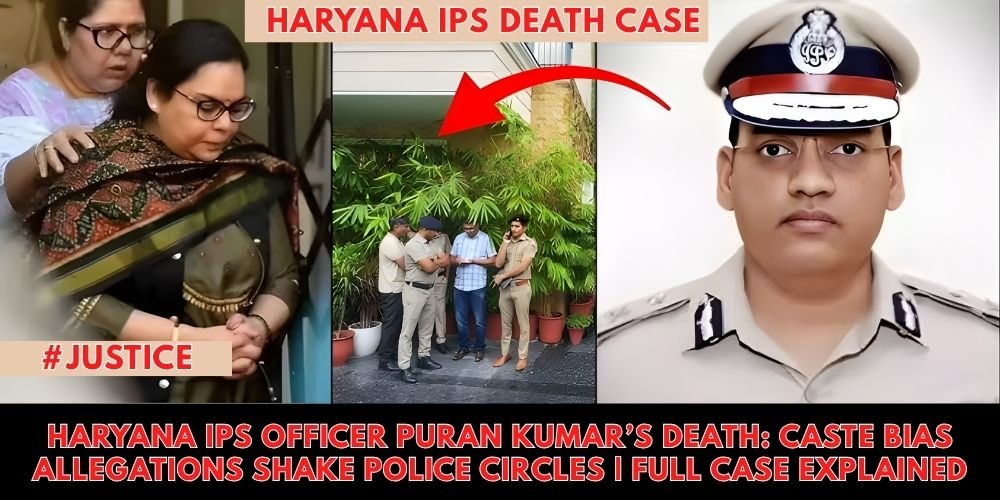
Haryana IPS Officer Puran Kumar’s Death: Caste Bias Allegations Shake Police Circles | Full Case Explained
Haryana IPS Death – The tragic suicide of Haryana-cadre IPS officer Y Puran Kumar on October 7, 2025, has cast a harsh spotlight on the deep-seated caste fault lines within the state’s police and bureaucracy. The subsequent official and political responses, including a stern commitment from Chief Minister Nayab Singh Saini, have kept this sensitive case at the center of public debate, exposing institutional weaknesses, systemic discrimination, and accountability challenges.
What Happened: Case Timeline
Y Puran Kumar, serving as the Inspector General of Police (IGP), was found dead from a gunshot wound in his Chandigarh residence. In his final note, Kumar named 16 senior officials—most notably Haryana DGP Shatrujeet Kapoor and Rohtak SP Narendra Bijarniya—alleging sustained harassment, public humiliation, and caste-based discrimination. According to his wife, IAS officer Amneet Puran Kumar, years of mental harassment had driven him to take his life. Kumar’s recent transfer to the Police Training Centre in Sunaria followed an embroiled tenure as Rohtak Range IG, marked by multiple controversies and professional isolation.
Previous Complaints and Accusations
Kumar had persistently raised allegations against colleagues and superiors for discrimination and harassment. In May 2021, he lodged a formal complaint against then-DGP Manoj Yadava, accusing him of humiliation related to his caste and demanding FIR registration under the SC/ST (Prevention of Atrocities) Act, 1989. Notably, after a temple visit in August 2020, only Kumar was questioned about permission, while his colleague Abhishek Jorwal faced no such scrutiny. This differential treatment reinforced Kumar’s sense of targeted humiliation. Kumar also voiced concerns over alleged illegal surveillance in 2021, claiming unethical access to his mobile phone’s internet protocol records and chats by other officials. These issues, he stated, were never satisfactorily addressed, escalating his distress.
Haryana IPS officer Y. Puran Kumar Ji ended his life due to unbearable caste-based harassment. This tragic incident is a blot on our society. Today, @INCSCDept Chairman @AdvRajendraPal Ji met the family of Y. Puran Kumar Ji in Chandigarh and shared their grief. pic.twitter.com/hdb7wA5sEs
— Indian Overseas Congress (@INCOverseas) October 10, 2025
Family’s Demands and Grievances
Since Kumar’s death, his family—led by wife Amneet—has been vocal in seeking immediate suspension and arrest of all officers named in the suicide note. She alleged dilution of charges in the FIR and called for its amendment to list all accused officers accurately, invoking the correct provisions of the SC/ST Act. The family withheld consent for post-mortem proceedings, citing lack of proper consultation and demanding a transparent, fair investigation. Amneet described the FIR copy as lacking necessary details, thereby compromising the probe’s integrity.
Official Investigation
A six-member Special Investigation Team (SIT), led by UT IGP Pushpendra Kumar, was constituted to examine all facets of the case, collect evidence, interview key witnesses, and prepare a comprehensive report. The FIR, based on Kumar’s suicide note, includes abetment to suicide and relevant sections under the SC/ST Act. The SIT can co-opt additional experts if needed, and their probe is ongoing, with a commitment to leaving no stone unturned. Meanwhile, Rohtak SP Narendra Bijarniya was transferred—one of the key demands from Kumar’s family.
Government Response
Chief Minister Nayab Singh Saini publicly assured that anyone found guilty would face action, irrespective of position or influence, emphasizing that no one is above the law. The Haryana government engaged with Kumar’s family to allay their grievances, transferring the implicated SP and urging them to allow the post-mortem for a complete investigation. Multiple ministers and senior officials have met the family, signaling an official commitment to justice and transparency.
Political Reactions
The incident provoked sharp reactions from political leaders nationally. Congress leader Sonia Gandhi wrote to Amneet Puran Kumar, acknowledging the tragedy as a “reminder of prejudiced and biased attitudes” among the powerful that deny social justice. Punjab Chief Minister Bhagwant Mann demanded strict adherence to law, while Telangana Chief Minister A Revanth Reddy called Kumar’s suicide a “stark example of attacks in the name of caste,” noting that such harassment at the senior ranks reflects societal malaise impacting ordinary citizens as well. Across party lines, the call for an impartial investigation and accountability has resonated.
Broader Implications: Caste and Bureaucracy
Kumar’s death and his detailed allegations lay bare the persistent caste divides in Indian institutions—especially in Haryana’s police and bureaucratic structures. The case highlights how caste bias continues to affect the working environment and personal dignity of even the most senior officials. It also brings forth the challenges faced by whistle-blowers and victims in securing justice within hierarchical systems resistant to internal scrutiny.
What Lies Ahead
While the ongoing SIT investigation is expected to deliver its findings, this tragedy stirs urgent reflection on deliberateness, transparency, and empathy in policy-making and administration. Continued public and political pressure may ensure accountability, but healing the social and institutional wounds revealed by Kumar’s suicide will require much deeper reforms.
The death of IPS officer Y Puran Kumar is not just a sobering personal tragedy—it is a clarion call for systemic change, demanding accountability, justice, and renewed commitment toward an equitable, discrimination-free bureaucracy in Haryana and beyond.