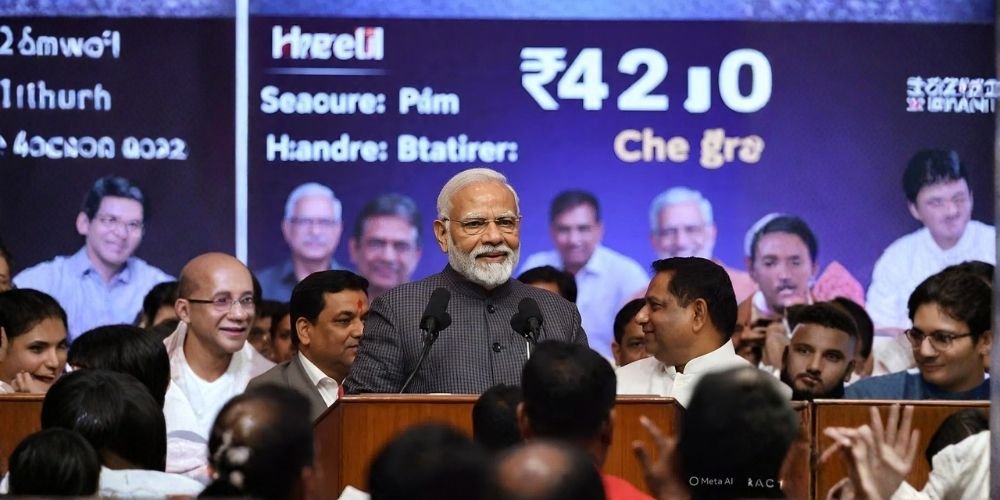
Modi Launches Two Ambitious Schemes for Farmers Amid Bihar Assembly Elections: A ₹42,000-Crore Push Toward Self-Reliant Agriculture
As Bihar gears up for the Assembly elections, Prime Minister Narendra Modi has once again placed agriculture at the heart of his development narrative. In a major announcement that could have far-reaching implications for India’s rural economy, the Prime Minister launched two significant agricultural initiatives — the Pradhan Mantri Dhandhanya Krishi Yojana and the Pulses Self-Reliant Mission — with a combined outlay of nearly ₹42,000 crore.
The schemes aim to boost productivity, reduce import dependency, and modernize India’s agricultural infrastructure, reaffirming the government’s commitment to making farmers “atmanirbhar,” or self-reliant.
The Push for Agricultural Transformation
Speaking at a rally during the Bihar election campaign, PM Modi underscored that these initiatives were not just election season promises but part of a broader vision to strengthen India’s agricultural base. “Unfortunately, previous governments abandoned agriculture to its own devices. There was no vision or thought from the government for agriculture,” he said, sharply criticizing past administrations for neglecting the backbone of India’s economy.
Modi highlighted that since his government came to power in 2014, consistent reforms and investment in technology, irrigation, and farmer income support have doubled India’s agricultural exports over 11 years. This has transformed the sector into one of the key contributors to India’s growth story, making the country more resilient to global supply chain disruptions.
'किसान सम्मान निधि योजना' के तहत बिहार के 59 लाख किसानों के खाते में 1179 करोड़ रुपये सीधे जमा! #सशक्त_बिहार_आत्मनिर्भर_भारत#AtmanirbharBharat pic.twitter.com/GpZzGwzfNb
— BJP Bihar (@BJP4Bihar) July 9, 2020
Pradhan Mantri Dhandhanya Krishi Yojana: Building Stronger Rural Foundations
The Dhandhanya Krishi Yojana, with a budgetary allocation of ₹24,000 crore, focuses on improving productivity and agricultural infrastructure across 100 identified districts. The scheme seeks to create a robust farm-to-market ecosystem that minimizes post-harvest losses and enhances value addition.
Key objectives include:
- Upgrading storage and warehousing capacities to reduce wastage.
- Setting up advanced processing units to increase farmers’ income through value-added products.
- Improving irrigation and digital access for crop planning and monitoring.
- Boosting logistics and cold chain networks, linking remote districts directly to wholesale markets.
This initiative aims to address one of the most persistent challenges in Indian farming — low post-harvest returns due to inefficient infrastructure. By equipping farmers with better access to technology and supply chains, the Yojana seeks to transform India’s agricultural landscape into a more organized and profitable sector.
Pulses Self-Reliant Mission: Moving Toward Food Security Independence
With ₹11,440 crore earmarked for achieving self-sufficiency in pulses, the Pulses Self-Reliant Mission represents a strategic move to reduce imports of essential protein-rich crops like tur, urad, and masoor dal. India currently imports around 10–12% of its total pulse demand, making it vulnerable to international price fluctuations.
The mission’s framework focuses on:
- Expanding the area under pulse cultivation, especially in drought-resistant regions.
- Deploying high-yield, climate-resilient pulse varieties developed through research collaborations with ICAR and state agricultural universities.
- Providing better procurement prices and minimum support assurance to incentivize farmers.
- Strengthening seed distribution systems and supporting innovation through digital advisory platforms.
This initiative aligns closely with India’s larger goal of nutritional security — ensuring that every household has access to affordable sources of plant-based protein while also reducing fiscal pressure from imports.
Linking Policy with Political Messaging
Announcing these schemes in the backdrop of Bihar’s election campaign carries clear political undertones. Bihar, a predominantly agrarian state, has long grappled with issues like small landholdings, low mechanization, and inadequate rural infrastructure. By unveiling these mega-schemes during election season, the Prime Minister has signaled a targeted push to attract rural voters while reiterating his government’s broader vision of empowering farmers.
At the same time, the rollout reflects a continuation of the government’s 2014–2025 agricultural reform roadmap — from the Pradhan Mantri Fasal Bima Yojana and PM-KISAN income support program to the digitalization of agri-markets under e-NAM. Together, these initiatives form an integrated policy framework centered on technology, sustainability, and global competitiveness.
India’s Broader Agricultural Outlook
PM Modi emphasized that India’s past dependency on imports — especially in pulses and edible oils — is gradually being replaced by domestic production strength. He stated that the country’s agricultural exports have nearly doubled in the past decade, highlighting surpluses in commodities like rice, sugar, and marine products.
The government’s vision, he added, is to “reduce imports, raise exports, and ensure that the Indian farmer becomes a global player in food production.” This export-oriented mindset marks a distinct shift from subsistence agriculture to commercially viable farming, aligning with the larger objective of becoming a $5-trillion economy.
Conclusion
The launch of the Dhandhanya Krishi Yojana and the Pulses Self-Reliant Mission represents a decisive step in reforming India’s agricultural sector through large-scale investment, innovation, and infrastructure development. As Bihar’s farmers listen closely to these promises in the heat of election season, the schemes also raise broader expectations — that the next phase of India’s agricultural evolution will be both inclusive and transformative.